
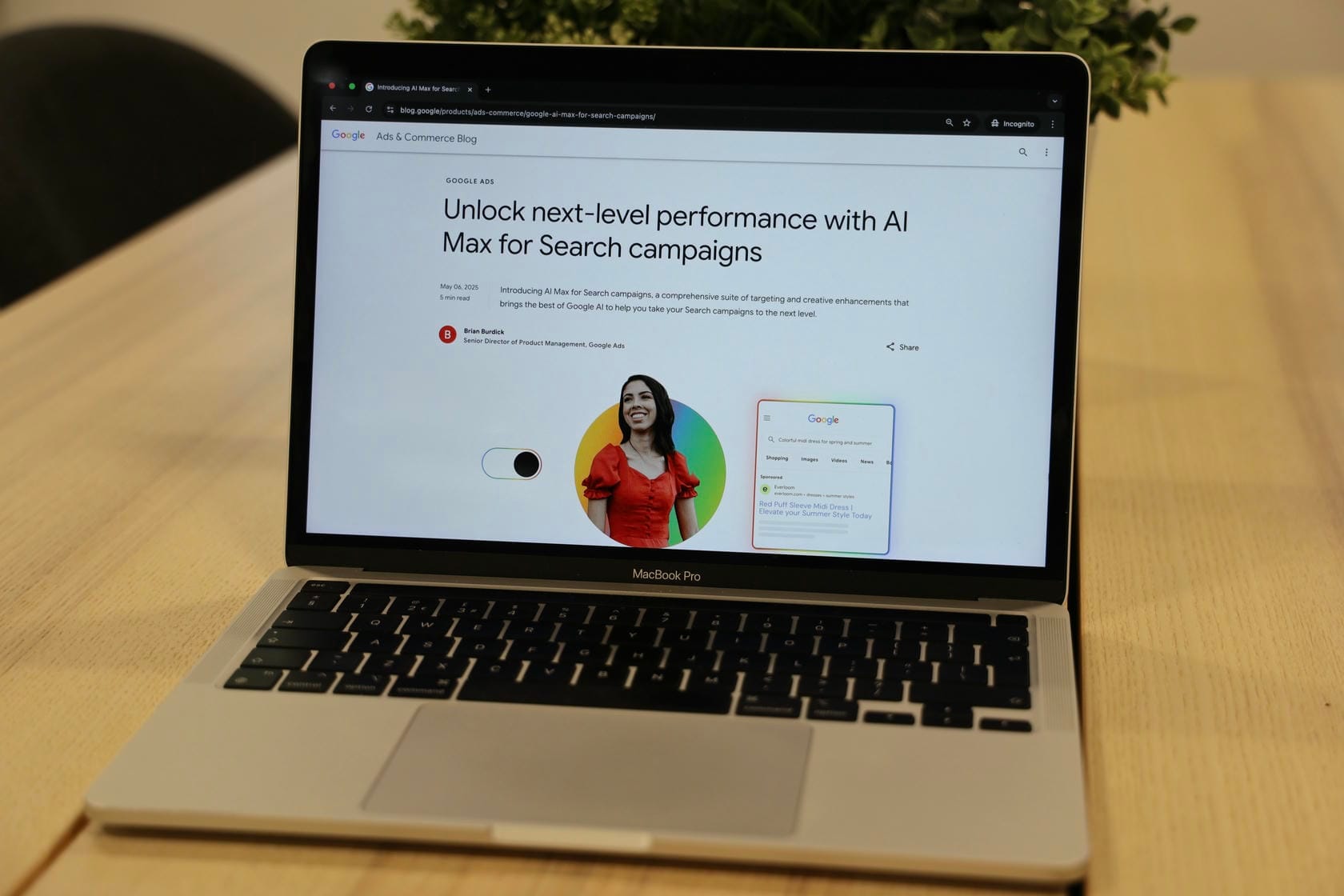
Google Ads is becoming more automated, and if you have recently looked at your Search campaign settings, you may have noticed something called AI Max.
But what exactly is AI Max for Google Ads? Does it replace keywords? Is it the same as Performance Max? And, more importantly, should a business simply switch it on and let Google’s AI take over?
The short answer is: AI Max changes how Google can find searches, create ad variations and select relevant landing pages, but it does not remove the need for good campaign strategy.
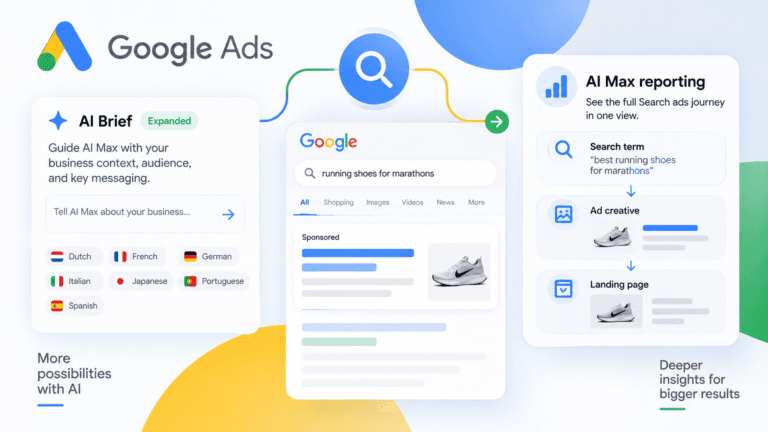
AI Max is an optimisation layer within existing Google Search campaigns rather than a completely new campaign type. It brings together features including expanded search-term matching, text customisation and Final URL Expansion.
For South African businesses investing in Google Ads, understanding what these changes actually mean is becoming increasingly important.
What is AI Max for Google Ads?
AI Max is Google’s collection of AI-powered targeting and creative features for Search campaigns.
Instead of relying only on the keywords you manually select, AI Max can use broader signals from your keywords, ad assets and website to identify relevant searches and determine how your ads and landing pages should respond.
Think of it this way:
Traditional Search campaign:
Keyword → Ad → Landing page
AI Max-enabled Search campaign:
Search intent + keywords + website content + ad assets + other signals → AI-assisted matching → tailored ad → relevant landing page
The second approach gives Google more flexibility to interpret what a person is actually looking for.
That does not mean your keywords, website or campaign structure suddenly stop mattering. In fact, as automation increases, the quality of the information you give Google becomes even more important.
How does AI Max work?
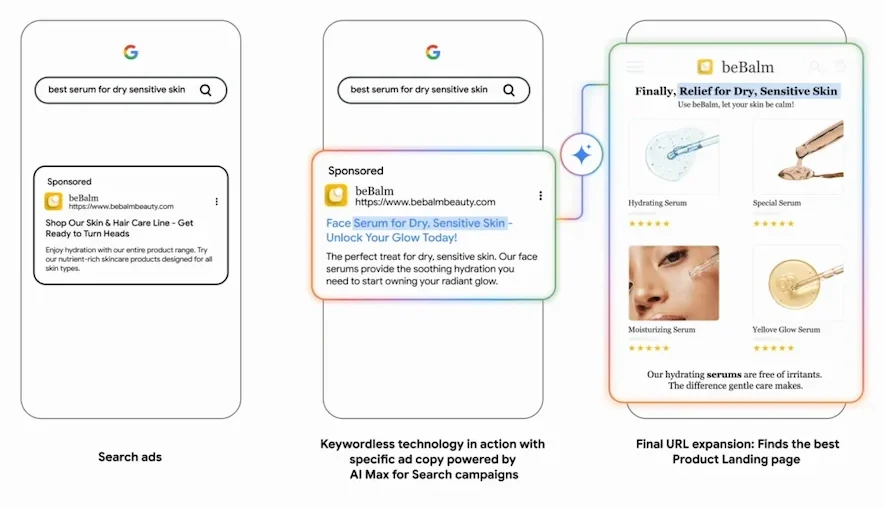
AI Max currently brings several capabilities together within Search campaigns.
1. Search term matching
One of the biggest changes is how Google can find relevant searches.
AI Max can use broad match, asset-based signals and keywordless technology to expand the reach of a Search campaign beyond the searches you may have specifically anticipated.
This matters because customers do not always search for your service using the exact wording you expected.
For example, a business selling website design in Johannesburg might target:
“web design Johannesburg”
But a potential customer could search:
- website company for small business
- professional website designer near me
- ecommerce website development Johannesburg
- who can redesign my business website
- affordable website development for a company
These searches may communicate similar intent without using exactly the same keywords.
AI Max gives Google more scope to identify those relationships.
That can create opportunities for additional relevant searches , but it also means advertisers need to pay attention to the searches actually generating traffic and conversions.
Automation is not a substitute for monitoring.
2. Text customisation
AI Max can also generate additional headlines and descriptions for Search ads.
Google says text customisation uses information such as your domain, landing-page content, existing advertisements and keywords, together with generative AI, to create additional assets designed around the context of a search.
This is useful because the same service can be searched for in many different ways.
Someone searching for:
“Google Ads agency Johannesburg”
may have a different intent from someone searching:
“help with Google Ads for small business”
AI Max can use the available information to adapt the messaging.
However, there is an important lesson here for businesses:
Your website content becomes part of the advertising equation.
If your website clearly explains what you do, who you help, where you operate and what makes your service different, Google has better information to work with.
If your website is vague, outdated or full of generic marketing language, giving Google more automation does not magically fix the underlying problem.
3. Final URL Expansion
Final URL Expansion allows Google to send a user to a relevant page on your website rather than automatically sending every click to the same landing page.
Google says AI Max can select relevant URLs based on the user’s query and the theme of the ad group.
For example, imagine a digital agency has separate pages for:
- Google Ads
- SEO
- Web Design
- Ecommerce
- Local SEO
A person searching specifically for ecommerce website development may be better served by the ecommerce page than the agency’s homepage.
That sounds simple, but it highlights something many advertisers overlook:
Your Google Ads campaign and your website cannot be treated as completely separate systems.
If you want to understand why clicks don’t necessarily turn into enquiries, see our guide on why your Google Ads aren’t converting.
Is AI Max the same as Performance Max?
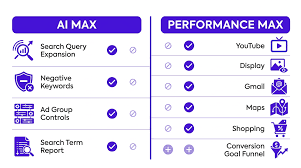
No.
The names are similar, but they serve different purposes.
AI Max is an optimisation layer for Search campaigns.
Performance Max is a broader Google Ads campaign type designed to access Google’s advertising inventory across multiple channels.
Google specifically describes AI Max as a suite of features for Search campaigns rather than a new campaign type.
So if you’re already running Search campaigns, AI Max is not simply telling you to replace them with Performance Max.
It is changing how those Search campaigns can operate.
This distinction is important when comparing your advertising options because Search, Performance Max, SEO and other channels all serve different roles in a broader acquisition strategy.
You can also read more about the relationship between paid search and organic visibility in our guide to Google Ads vs SEO in South Africa.
Does AI Max replace keywords?
Not exactly.
This is one of the easiest areas to misunderstand.
AI Max expands how Google can identify relevant searches, including through broad match and keywordless technology. But that does not mean advertisers should simply throw away their keyword strategy and stop thinking about search intent.
Your keywords still provide useful signals about:
- the products or services you offer
- the themes within your ad groups
- the searches you consider relevant
- the intent behind your campaigns
AI Max changes the role automation can play in interpreting those signals.
Google also provides controls around brands, URLs, locations and other aspects of campaign management, rather than making the campaign completely hands-off.
The better question therefore isn’t:
“Are keywords dead?”
It’s:
“How should I combine keyword strategy with Google’s increasing ability to interpret intent?”
That is a much more useful question for advertisers in 2026.
What’s changing with AI Max in 2026?
This is particularly relevant if you are managing an existing Google Ads account.
AI Max moved out of beta in April 2026, and Google has continued adding capabilities and controls during the year.
There is also an important September 2026 change.
Google says campaigns using the campaign-level broad match setting will automatically be upgraded to AI Max beginning in September 2026. Google has also announced automatic upgrades involving legacy features such as Dynamic Search Ads and automatically created assets.
That means AI Max is no longer something advertisers can simply treat as an experimental feature that may or may not become relevant later.
It is becoming part of the direction Google is taking Search advertising.
For businesses running Google Ads, that makes understanding the change more useful than simply reacting to it when an account setting changes.
Should you turn on AI Max?
There isn’t a universal answer.
AI Max gives Google more automation and more opportunities to interpret search intent, but whether that is useful for a particular campaign depends on the campaign’s objectives, data and setup.
AI Max may be worth testing when:
- conversion tracking is properly configured
- your website has useful, relevant service content
- your landing pages match the services you’re advertising
- your campaign has enough data to evaluate changes
- you’re comfortable monitoring search terms and conversions
- you want to explore additional relevant search demand
You should be more cautious when:
- conversion tracking is unreliable
- your website has very little relevant content
- your landing pages are poorly matched to your ads
- you don’t know which searches are producing qualified enquiries
- your campaign has significant irrelevant traffic
- you have strict requirements around which pages or messaging can be used
The important distinction is between automation and abandonment.
AI Max can automate parts of the optimisation process.
It doesn’t mean you should stop managing the campaign.
Your website matters more with AI Max
This is one of the biggest practical implications for businesses.
If AI Max can use information from your website for search matching, ad customisation and landing-page selection, your website becomes more than somewhere the visitor goes after clicking an ad.
It becomes part of the information Google uses to understand your business.
That makes things such as these increasingly important:
- clear service pages
- accurate descriptions of your services
- useful headings
- relevant supporting content
- clear location information
- strong internal linking
- focused landing pages
- consistent messaging
- clear calls to action
This is also where paid search and SEO begin to overlap.
A page does not have to be written solely for organic rankings to be useful to Google Ads. It needs to clearly communicate what the business offers and provide a relevant destination for the person who clicks.
If your website needs stronger foundations, our guide to SEO for small businesses in South Africa covers several of the same fundamentals.
AI Max and landing pages: relevance still matters
Imagine someone searches:
“Google Ads management for a small business in Johannesburg”
They click your advertisement and arrive on a generic homepage containing ten different services.
Compare that with a dedicated Google Ads page explaining:
- who the service is for
- what is included
- how campaigns are managed
- what businesses should expect
- what affects costs
- how enquiries are tracked
- how to get started
The second experience gives the visitor a clearer next step.
AI Max does not remove this basic marketing principle.
More sophisticated targeting cannot compensate indefinitely for a poor destination.
If you’re unsure whether your website is helping or hurting your advertising results, start with the fundamentals before adding more automation.
How to test AI Max without guessing
If you decide to test AI Max, don’t make the decision based on clicks alone.
Before changing anything, establish a baseline.
Record metrics such as:
- conversions
- qualified leads
- cost per conversion
- conversion rate
- conversion value
- search terms
- landing pages
- spend
- revenue or lead value where available
Then make the change and give the campaign enough time to produce meaningful data.
Google also provides AI Max experiment functionality so advertisers can test AI Max against a control rather than relying entirely on before-and-after comparisons.
A practical testing process could look like this:
Step 1: Check conversion tracking
Make sure Google is actually measuring the actions that matter.
A form submission is not necessarily the same as a qualified enquiry.
Step 2: Review your existing search terms
Understand what is already triggering your advertisements.
Step 3: Check your landing pages
Make sure the pages associated with your services are relevant and useful.
Step 4: Review your exclusions
Consider which searches, brands, URLs or other traffic you don’t want.
Step 5: Define the business outcome
Decide whether success means leads, qualified leads, sales, revenue or another measurable outcome.
Step 6: Test
Don’t change five other major campaign settings at the same time if you want to understand what AI Max contributed.
Step 7: Review the data
Look beyond impressions and clicks.
Ask:
Did we generate better business outcomes?
That’s the metric that matters.
What should you monitor after enabling AI Max?
AI Max introduces additional reporting designed to help advertisers understand how Google’s automation is contributing to the campaign. Google provides reporting around search terms, keywords, landing pages and assets.
Pay particular attention to:
Search terms
Are the searches relevant to what you actually sell?
Qualified conversions
Are people taking meaningful actions, or are you simply getting more low-quality enquiries?
Cost per lead
Is additional reach coming at an acceptable cost?
Landing pages
Which pages are receiving traffic?
Are those pages actually appropriate for the search intent?
Ad assets
Which messaging is being used and what relationship does it have with conversions?
Location performance
For a local business, are you reaching people in the areas you actually serve?
This is especially important for South African businesses targeting cities or regions rather than the entire country.
Common AI Max mistakes to avoid
1. Treating AI Max as “set and forget”
Automation still needs oversight.
Google’s systems can optimise against the signals they receive. Your job is to make sure those signals reflect the business outcome you actually care about.
2. Ignoring your website
If your website is unclear, AI has less useful information to work with.
3. Measuring clicks instead of customers
More traffic isn’t automatically better traffic.
A campaign generating 500 additional clicks but no meaningful enquiries has not necessarily improved.
4. Removing all campaign controls
AI Max includes controls and reporting. Use them.
Google provides options including brand settings, URL inclusions and exclusions, location controls and reporting designed to make AI Max more transparent.
5. Changing everything at once
If you change targeting, bidding, budget, landing pages and creative simultaneously, it becomes difficult to understand what caused the change in performance.
6. Assuming automation replaces strategy
It doesn’t.
The strategy still needs to answer:
Who are we trying to reach?
What are they searching for?
What do we want them to do?
What makes our offer relevant?
How will we measure whether it worked?
AI Max operates inside that strategy.
It doesn’t replace it.
What does AI Max mean for small businesses in South Africa?
For a small business, Google Ads can already feel complicated enough without another layer of automation.
The important thing is not to get caught up in every new Google Ads feature.
Start with the basics.
If you’re a Johannesburg based plumbing company, for example, your campaign needs to make it clear that you provide plumbing services, who you serve and where you operate.
If you’re an accountant in Pretoria, the same principle applies.
Your service pages, advertising, location signals, conversion tracking and messaging should all tell a consistent story.
AI Max may help Google discover additional relevant searches, but it still needs useful information from the business.
And your budget still matters.
If you’re planning a Google Ads campaign, it’s worth understanding the wider costs involved rather than assuming that your entire budget becomes ad spend. Our guide to Google Ads costs in South Africa breaks down the factors that can affect your overall investment.
AI Max isn’t a replacement for good marketing
The biggest misconception about AI Max is that more AI means less need for marketing expertise.
In reality, automation makes the quality of your inputs more important.
Google can help identify searches.
It can generate additional ad assets.
It can select potentially relevant landing pages.
But it cannot decide what a genuinely good offer looks like for your business.
It cannot fix a confusing website simply because AI is enabled.
And more clicks don’t automatically mean more customers.
The businesses that get the most value from increasingly automated advertising will still need to understand their customers, their market, their website and their numbers.
AI changes the mechanics.
It doesn’t remove the fundamentals.
Final thoughts
AI Max is part of a much bigger change happening in Google Search advertising.
Search campaigns are becoming less dependent on advertisers predicting every possible query and more dependent on Google’s ability to interpret intent using multiple signals.
For businesses, that creates both opportunities and responsibilities.
You need to give Google useful information.
You need accurate conversion tracking.
You need relevant landing pages.
You need to understand the searches generating your leads.
And you still need a strategy.
AI Max can automate more of the process. It doesn’t make the strategy optional.
If you’re considering Google Ads or trying to understand whether your existing campaigns are actually generating business, the first step isn’t necessarily turning on another feature.
It is understanding where your current marketing is losing potential customers, from search visibility to the website experience to the conversion itself.
That’s where a properly connected digital marketing strategy can make the difference.
AI Max for Google Ads: Frequently Asked Questions
No. AI Max is an optimisation layer within existing Search campaigns.
No. AI Max is specifically designed to enhance Search campaigns, while Performance Max is a separate campaign type that can access Google’s wider advertising inventory.
No. AI Max expands how Google can identify relevant searches using additional signals, including broad match and keywordless technology, but keywords remain part of Search campaign structure.
AI Max includes text customisation, which can generate additional headlines and descriptions using information from your ads, keywords, landing pages and domain.
Not necessarily. The right approach depends on the campaign, conversion tracking, website, objectives and level of control required. Testing and monitoring are more useful than assuming automation will improve every campaign.
s
