

How much does Google Ads cost? There is no single price that applies to every business. In South Africa, your Google Ads costs can range from a relatively small monthly test budget to tens of thousands of rands, depending on your industry, keywords, competition, location, campaign goals and how well your ads and website convert.
That can make budgeting difficult for a business owner. You may be wondering whether R2,000 is enough, whether you need to spend R10,000 a month, or whether Google Ads will simply eat through your budget without generating enough enquiries.
The important thing to understand is that Google Ads is not simply about how much you spend. It is about what you get from the money you spend.
A campaign generating 20 qualified enquiries from R10,000 can be far more valuable than one generating 100 low-quality clicks from the same budget.
So, how much should you budget for Google Ads?
For many South African small and medium-sized businesses, a practical starting point is around R5,000 per month in Google Ads spend, although the right figure depends heavily on your market and objectives.
Some businesses may be able to start with less. Others, particularly those targeting highly competitive keywords in industries such as legal services, finance, property or specialised professional services, may need considerably more.
Recent South African benchmarks show that search CPCs can vary significantly by industry, with reported ranges stretching from relatively low-cost clicks to R50 or more, while highly competitive sectors can go beyond R100 per click. These figures should be treated as planning benchmarks rather than fixed prices because your actual CPC is determined by the individual auctions your ads enter.
The better question is therefore not:
“How little can I spend on Google Ads?”
It is:
“What budget gives my business enough opportunity to generate useful traffic, leads or sales while still making financial sense?”
Google Ads does not have a fixed monthly price
One of the biggest misconceptions about Google Ads is that there is a standard monthly fee.
There isn’t.
Google Ads works through an auction. When someone searches for something related to your targeting, eligible advertisers compete for the opportunity to show an ad. Google considers factors including your bid, ad relevance, landing page experience, competition and the context of the search when determining Ad Rank and the actual cost of a click.
This means two businesses can target similar keywords and pay very different amounts.
It also means that simply increasing your budget does not automatically make your campaign better.
A poorly structured campaign with weak targeting and an irrelevant landing page can waste a much larger budget just as efficiently as a small one.
What does Google Ads cost per click?
Cost per click (CPC) is the amount you pay when someone clicks your ad.
There is no universal Google Ads CPC in South Africa.
Recent local benchmarks put many search campaigns somewhere around R5–R50 per click, although the actual range can be much wider depending on the industry and keyword. Highly competitive searches can exceed R100 per click.
For example, imagine you are a Johannesburg business targeting a keyword that costs R20 per click.
A monthly budget of R5,000 could theoretically generate around:
R5,000 ÷ R20 = 250 clicks
But this does not mean you will automatically get 250 customers.
Clicks are only the first step.
If 250 people visit your website and only five contact you, your campaign needs to be judged on the value of those five enquiries not simply the number of clicks.
Google also explains that your actual CPC can be lower than your maximum CPC because the amount you pay is influenced by the auction and the Ad Rank of competing advertisers.
What determines the cost of Google Ads?
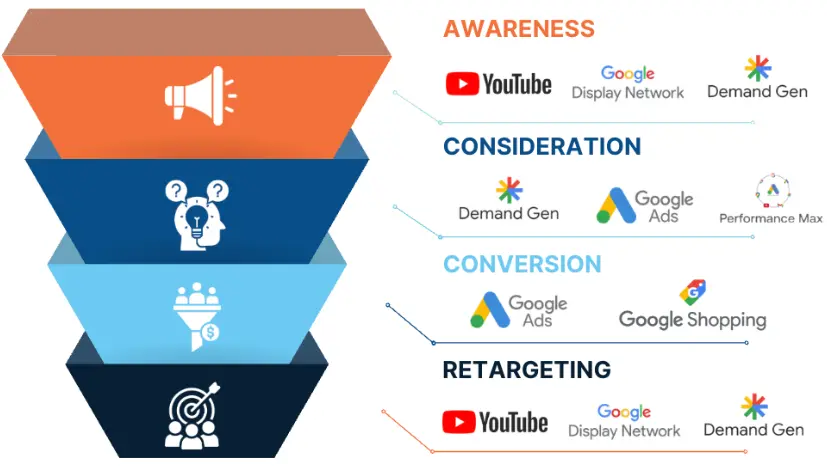
Several factors can push your Google Ads costs up or down.
1. Your industry
Some industries are much more competitive than others.
A business selling a low-cost consumer product may be competing against fewer advertisers than a company targeting high-value searches such as:
- lawyers
- accountants
- insurance
- property
- financial services
- business services
- specialised medical services
The more valuable a customer is to advertisers, the more competition there may be for that search.
That does not necessarily make Google Ads a bad investment. A R100 click can still make sense if one new customer is worth several thousand rand to your business.
2. The keywords you target
Not every keyword has the same commercial value.
Consider the difference between:
“digital marketing”
and:
“digital marketing agency Johannesburg”
The second search gives you much more information about what the person may actually be looking for.
A strong Google Ads strategy therefore isn’t about choosing the most popular keywords. It is about finding searches that indicate genuine buying intent.
3. Competition
If several businesses are competing for the same search, CPCs can increase.
But there is an important point here: the business with the biggest budget does not automatically win.
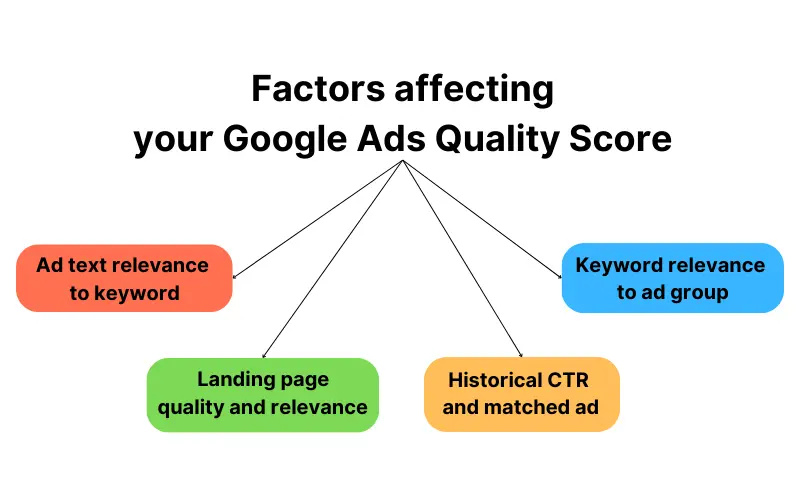
Google’s Ad Rank also considers factors such as ad quality, relevance and landing page experience. Google states that higher-quality ads can often achieve lower CPCs than lower-quality ads.
That is why campaign structure matters.
4. Your location
A campaign targeting one suburb is very different from one targeting all of South Africa.
For example, a Johannesburg business might choose to target specific areas where its customers are located rather than paying for clicks from people it cannot realistically serve.
Location can therefore influence both competition and the quality of the traffic you receive.
5. Your landing page
This is where many businesses lose money.
You can have a well-written advertisement that attracts exactly the right person, but if they land on a slow, confusing or irrelevant page, the opportunity can disappear.
Your landing page should answer the visitor’s question quickly:
Am I in the right place?
Then:
Can this business solve my problem?
And finally:
What should I do next?
Your website is part of your advertising investment, whether you realise it or not.
How much should a small business spend on Google Ads?
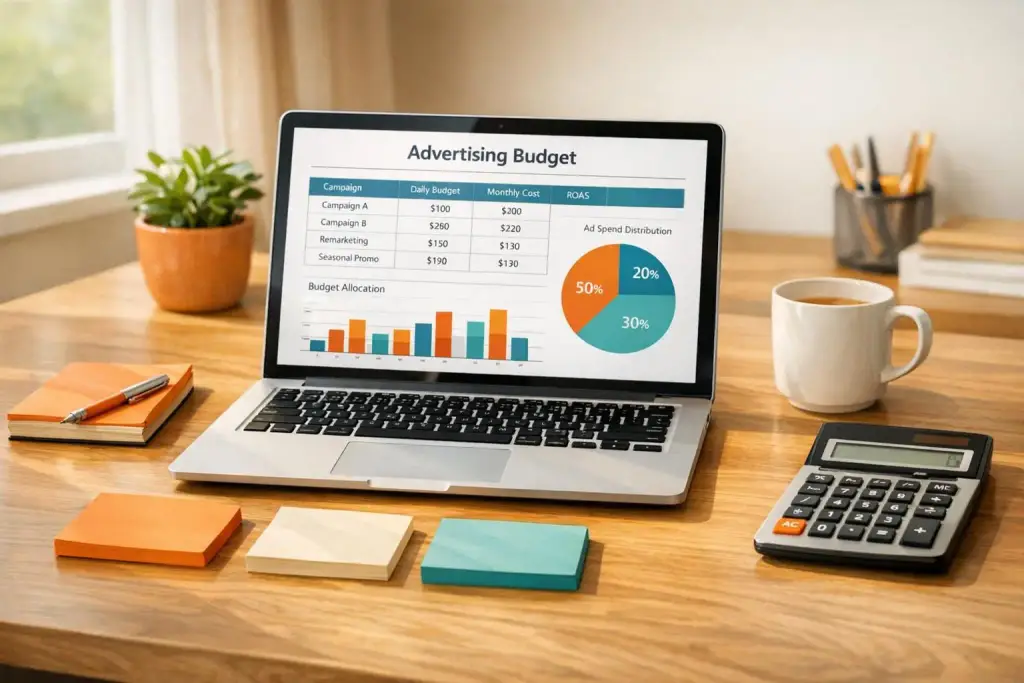
There is no universal minimum budget that guarantees results.
Google allows advertisers to choose their own average daily budget and change it when necessary. Google also explains that daily spend can vary, while monthly charging limits apply based on the campaign’s average daily budget.
However, there is a difference between being able to run Google Ads and having enough budget to properly test and optimise a campaign.
For many South African SMEs, starting around R5,000 per month in ad spend can provide a more useful testing point than spreading a tiny budget across numerous campaigns and keywords. Some businesses will need less; highly competitive markets may require substantially more. Local agencies and benchmark studies commonly use R5,000 as a practical starting point for meaningful search campaigns, but it should never be treated as a Google-mandated minimum.
A simple way to think about your budget
Instead of choosing a number because another business told you that it “works”, start with your economics.
Suppose:
- Your average customer is worth R4,000
- Your gross profit from that customer is R2,000
- You are comfortable spending R500 to acquire one customer
Your campaign should ultimately be designed around generating customers at or below an acceptable acquisition cost.
That gives you a much more useful target than simply saying:
“We have R5,000 for Google Ads.”
The budget should support the business goal, not become the goal itself.
Don’t confuse Google Ads spend with Google Ads management fees
This is another important cost that business owners often overlook.
Your total Google Ads investment may include:
1. Ad spend
This is the money paid to Google to run your advertisements.
2. Campaign management
If you use an agency or specialist, you may pay a separate management fee for strategy, campaign setup, keyword research, optimisation, reporting, testing and ongoing management.
3. Landing page or website costs
You may need a new landing page or improvements to your website before sending paid traffic to it.
4. Tracking and conversion setup
Proper conversion tracking is essential if you want to know whether your advertising is generating enquiries, calls, purchases or other valuable actions.
For example, you could have:
R8,000 Google Ads budget + R3,000 management = R11,000 total monthly investment
The R8,000 is your advertising spend. The R3,000 is the cost of managing the campaign.
Those are two different expenses and should be evaluated separately.
Why spending more on Google Ads does not always mean getting more customers
This is one of the most expensive misconceptions in paid advertising.
Imagine you are getting poor results from a R5,000 campaign.
Increasing it to R10,000 may simply produce twice as much wasted traffic.
Before increasing the budget, ask:
- Are we targeting the right searches?
- Are people clicking but not enquiring?
- Are irrelevant searches triggering our ads?
- Is the landing page convincing?
- Is conversion tracking working?
- Are we targeting the right locations?
- Are our ads clearly communicating the offer?
- Are we following up quickly enough with leads?
Sometimes the solution is better campaign strategy, not a bigger budget.
Google itself notes that ad quality and landing page experience are important components of Ad Rank and can influence the CPC and performance of your ads.
What happens if your Google Ads budget is too low?
A small budget isn’t automatically a bad budget.
The problem occurs when the budget is too small for the market you’re trying to compete in.
For example, if your average CPC is R30 and you only spend R1,000 a month, you have roughly enough budget for 33 clicks before considering other variables.
If your website converts 5% of those visitors, you might generate only one or two leads.
That does not necessarily mean Google Ads doesn’t work.
You may simply not have enough data or traffic to make reliable decisions.
This is why spreading a small budget across five campaigns can be particularly problematic.
A better approach may be to concentrate the available budget on your highest-intent service or product first.
What if you have a limited budget?
If your budget is limited, don’t try to advertise everything.
Start with the part of your business where:
customer intent + profitability + demand overlap.
For example, a service business offering ten different services might be better off starting with two or three high-value services rather than creating separate campaigns for all ten.
Focus your budget.
Target commercially relevant searches.
Send visitors to relevant pages.
Track enquiries.
Then expand when the data supports it.
This is usually far more sensible than launching a large campaign simply because you want your business to “be everywhere.”
Google Ads vs SEO: which costs more?
Google Ads and SEO solve different problems.
With Google Ads, you pay for advertising exposure and clicks. Once you stop funding the campaign, the paid traffic generally stops.
With SEO, you invest in improving your organic visibility. It can take longer to build momentum, but successful SEO can continue generating organic traffic without paying Google for each click.
For many businesses, the strongest long-term strategy isn’t necessarily Google Ads or SEO.
It can be Google Ads + SEO.
Google Ads can help you capture demand now while SEO works towards building sustainable organic visibility over time.
The right balance depends on your goals, competition, budget and how quickly you need results.
How to calculate whether Google Ads is worth it
Don’t judge your campaign by CPC alone.
A better calculation is:
Cost per lead = Google Ads spend ÷ qualified leads
Then:
Cost per customer = Google Ads spend ÷ customers acquired
And ultimately:
Return on ad spend (ROAS) = revenue generated ÷ ad spend
For example, if you spend R10,000 and generate R40,000 in attributable sales:
R40,000 ÷ R10,000 = 4x ROAS
That sounds much more meaningful than simply saying:
“Our average CPC was R18.”
The CPC matters, but the business outcome matters more.
How to reduce wasted Google Ads spend
If your campaign is generating clicks but not enough business, there are several areas worth investigating.
Target search intent, not just keywords
Someone searching for “what is SEO” is at a very different stage from someone searching for “SEO agency Johannesburg pricing.”
Your campaign should reflect the difference.
Use negative keywords
Negative keywords help prevent your ads from appearing for searches that are irrelevant to what you sell.
This can be particularly important when broad or ambiguous search terms attract unwanted traffic.
Improve your landing pages
Your advertisement makes a promise.
Your landing page needs to continue that conversation.
If someone searches for “Google Ads agency Johannesburg” and lands on a generic homepage that says very little about Google Ads, you are making the visitor work too hard.
Track actual conversions
Clicks and impressions tell you what happened before the customer contacted you.
Conversion tracking helps you understand what happened afterwards.
Without reliable tracking, it becomes difficult to know whether you are getting customers or simply buying traffic.
Optimise instead of constantly increasing the budget
A well-managed campaign should be reviewed regularly.
Look at which searches generate leads, which ads attract qualified visitors, which locations perform best and where money is being wasted.
Then make informed changes.
Is Google Ads worth it for a small business?
It can be, but only when the numbers make sense.
Google Ads can be particularly useful for businesses selling services where customers actively search for a solution.
Instead of waiting for someone to discover your business organically, you can place your offer in front of people who are already looking for what you provide.
But Google Ads won’t fix a weak offer, poor website, unclear messaging or bad sales follow-up.
Paid traffic amplifies what is already there.
If your website converts well and your sales process is strong, Google Ads can accelerate growth.
If the underlying customer journey is broken, Google Ads can accelerate the waste.
The real cost of Google Ads is not your budget—it’s wasted budget
If you are trying to decide whether to spend R3,000, R5,000, R10,000 or more on Google Ads, don’t start with the budget.
Start with the customer.
What are they searching for?
What problem are they trying to solve?
What is a new customer worth to your business?
How many customers do you need?
What conversion rate can your website realistically achieve?
Once you answer those questions, your Google Ads budget becomes a business decision rather than a guess.
At Signal Growth Partners, we believe Google Ads should be connected to the bigger picture, not treated as a standalone traffic generator. Your targeting, ads, landing pages, conversion tracking and overall digital marketing strategy all need to work together.
Not sure what Google Ads should cost for your business?
Let’s look at your industry, target market, search demand and business goals and work out what a realistic advertising budget could look like.
Don’t just spend more. Spend with a strategy.
