

“I need a website that helps my business get found, trusted and contacted.”
That is a very different request from simply saying, “I need a website.”
In 2026, having a website is no longer enough. Your customers are searching online, comparing businesses, checking reviews, evaluating your credibility and deciding within moments whether your business looks like the right fit for them.
Your website is often part of that decision.
For businesses looking for a professional web designer in Johannesburg, the real question shouldn’t only be whether someone can create an attractive website. It should be whether the website can help your business get found by the right people, communicate value clearly, build trust and turn interest into enquiries.
That is where the role of a modern web designer has changed.
A professional web designer is no longer simply responsible for colours, fonts, images and page layouts. Good web design brings together user experience, search visibility, content structure, mobile performance, conversion strategy and your wider business goals.
Your website should work as part of your business, not sit separately from it.
What Does a Web Designer Do in 2026?
A modern web designer sits at the intersection of design, technology, marketing and business strategy.
Their role may include:
- Planning the structure and navigation of a website
- Designing user-friendly page layouts
- Creating responsive experiences for mobile, tablet and desktop
- Structuring content around customer needs and search intent
- Establishing clear calls to action
- Supporting SEO-friendly website architecture
- Improving the user journey from landing page to enquiry
- Considering website speed and performance
- Integrating forms, booking systems, ecommerce functionality and other tools
- Building trust through professional design and useful content
- Testing the website before launch
- Supporting ongoing improvements after launch
The objective is not simply to create something that looks professional.
The objective is to create a website that works for the business.
For a Johannesburg business, that could mean helping a customer find your service through Google, understand what you offer, see evidence that your business is trustworthy and contact you without unnecessary friction.
A Web Designer Should Start With Your Business, Not Your Homepage
One of the biggest mistakes businesses can make is starting a website project by immediately discussing colours, fonts and homepage images.
Those things matter, but they should not be the starting point.
A professional web design process should begin by understanding the business.
That means considering questions such as:
- Who are your ideal customers?
- What problems do you solve?
- What services or products generate the most value?
- Where are your customers located?
- How do people currently find your business?
- What actions do you want visitors to take?
- Who are your competitors?
- What makes your business different?
- What information do potential customers need before contacting you?
These questions influence everything from the website structure to the content and calls to action.
A business targeting customers in Johannesburg may need a very different website strategy from a company selling products nationally or internationally.
The website should therefore be built around business objectives and customer needs, rather than simply following a visual trend.
Web Design and SEO Should Work Together
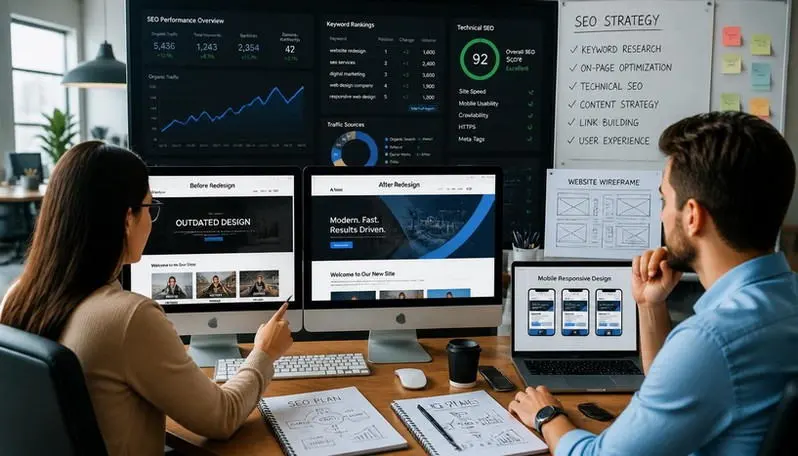
Web design and SEO are sometimes treated as two completely separate activities.
They shouldn’t be.
A website can look excellent and still struggle to generate organic traffic if its structure, content and technical foundations do not support search visibility.
Likewise, a website can attract visitors from Google but fail to convert them if the user experience is confusing.
Good web design helps create the environment in which SEO can perform.
This includes considering:
- Logical page hierarchy
- Descriptive URLs
- Clear headings
- Internal linking
- Mobile usability
- Image optimisation
- Page performance
- Accessible content
- Crawlable navigation
- Useful service pages
- Clear content structure
It also means understanding why someone is searching.
For example, a person searching for “web design Johannesburg” is likely to have a different intent from someone searching for “how much does a website cost in South Africa?”
The first may be evaluating providers.
The second may still be researching and comparing options.
Your website should be able to address both stages of the customer journey.
Search Intent Should Influence Website Structure
One of the most important developments in modern SEO is the increasing focus on satisfying the reason behind a search.
Search intent asks:
What does the person actually want to accomplish?
Consider a potential customer searching for:
“ecommerce website design Johannesburg”
They may want to:
- Find a company that provides ecommerce development
- Compare providers
- Understand what ecommerce development involves
- Find out what features are available
- Estimate project costs
- Request a quotation
A strong ecommerce service page should therefore do more than say:
“We build ecommerce websites.”
It should explain what is included, who the service is for, what platforms or functionality may be available, what the process involves and how the visitor can take the next step.
This is where SEO and web design become closely connected.
Your website needs pages that answer the questions your potential customers are actually asking.
A Beautiful Website Is Not Necessarily an Effective Website
Visual design matters.
Your website represents your business, and an outdated or poorly designed website can affect how visitors perceive your brand.
But visual appearance is only one part of effective web design.
A good website should quickly help visitors answer five questions:
- Who are you?
- What do you offer?
- Who is it for?
- Why should I trust you?
- What should I do next?
If a visitor has to search through several pages to understand what your company does, the design is creating unnecessary friction.
Likewise, if your most important service has no clear call to action, visitors may leave without making contact.
Effective web design combines visual communication with usability and business objectives.
How Web Design Can Influence Conversions
Getting people to your website is only part of the process.
The next question is:
What happens when they arrive?
A conversion does not always mean an online sale.
For a service-based business, a conversion could be:
- Completing a quotation form
- Calling the business
- Sending a WhatsApp message
- Booking a consultation
- Requesting more information
- Signing up for an email list
- Downloading a useful resource
The website should make those actions easy to understand and easy to complete.
This can involve strategically placed calls to action, shorter forms, clear service descriptions, trust signals, testimonials, case studies and straightforward navigation.
For businesses that sell through quotations rather than fixed online prices, the website can be designed around qualified enquiries rather than a traditional ecommerce checkout.
That is particularly important for professional services where every project may have different requirements.
Why Mobile-First Web Design Matters
A potential customer does not necessarily visit your website while sitting at a desk.
They may discover your business on a smartphone while travelling, during a lunch break or while comparing several companies.
That makes responsive and mobile-friendly design essential.
A mobile visitor should be able to:
- Read your content comfortably
- Navigate your website easily
- Find your contact details
- Understand your services
- Tap a phone number or WhatsApp link
- Complete an enquiry form
- Access important information without excessive scrolling or zooming
Mobile design should not simply be an afterthought where a desktop website is squeezed onto a smaller screen.
The experience should be considered across different screen sizes from the beginning.
Website Speed Is Part of the User Experience
Visitors expect websites to respond quickly.
Large images, unnecessary scripts, poorly configured plugins and inefficient website infrastructure can all contribute to performance problems.
Performance is therefore both a technical and user-experience consideration.
A professional web designer should consider factors such as:
- Image sizes and formats
- Page structure
- Font loading
- Third-party scripts
- Plugin usage
- Hosting
- Caching
- Code efficiency
- Core Web Vitals
Performance should also be monitored after launch rather than treated as a one-time task.
A website can become slower as new plugins, tracking tools, images and functionality are added.
Accessibility Should Be Part of Good Web Design
A professional website should be usable by as many people as reasonably possible.
Accessibility considerations can include:
- Sufficient colour contrast
- Descriptive alternative text for meaningful images
- Logical heading structures
- Keyboard-friendly navigation
- Readable typography
- Clear links and buttons
- Forms with understandable labels
Accessibility isn’t simply a technical checklist.
It is part of creating a better experience for visitors.
It can also encourage designers and developers to create clearer, more usable websites overall.
Trust Is One of the Most Important Functions of a Business Website
Before contacting your business, a potential customer may be asking:
“Can I trust this company?”
Your website can help answer that question.
Useful trust signals may include:
- Customer reviews
- Testimonials
- Case studies
- Certifications
- Professional affiliations
- Business information
- Team profiles
- Clear contact details
- Real project examples
- Transparent service information
- Relevant experience
The right trust signals depend on the industry.
For example, a professional services company may benefit from credentials, qualifications and testimonials, while an ecommerce business may need strong product information, secure payment information, delivery details and customer reviews.
A modern web designer should consider these trust elements as part of the overall customer journey.
Web Design for Small Businesses Requires a Different Approach
Small businesses do not necessarily need enormous websites.
They need websites that make good use of the resources available to them.
For many small businesses, the priorities may be:
- Establishing credibility
- Explaining their services clearly
- Appearing in relevant local searches
- Generating enquiries
- Making contact easy
- Building a foundation for future growth
A focused website with well-written service pages can sometimes be more effective than a large website filled with unnecessary information.
The important question is not:
“How many pages should my website have?”
It is:
“Which pages do my customers need to make an informed decision?”
This customer-focused approach can make professional web design for small businesses more practical and commercially valuable.
Local SEO and Web Design for Johannesburg Businesses
If your business serves a specific geographical market, your website should communicate that relevance naturally.
For a Johannesburg business, this may involve creating useful content and service pages that clearly establish:
- The areas you serve
- The services you provide
- Who your services are for
- Relevant local information
- Your physical or service-area presence where appropriate
Local SEO should never mean filling pages with repetitive location keywords.
Instead, Johannesburg should be part of the genuine context of the business.
For example, a web designer in Johannesburg should be able to demonstrate an understanding of the businesses and customers they serve rather than simply adding “Johannesburg” to every heading.
Your Website Content Matters as Much as the Design
A website’s visual design can attract attention, but content helps visitors understand the business.
Good website content should be:
- Clear
- Useful
- Specific
- Accurate
- Relevant to the target audience
- Organised logically
- Written for people rather than search engines
Each important service should have enough information for someone to understand what the service involves and whether it is relevant to them.
This is particularly important for SEO.
Instead of creating one generic “Services” page containing a few paragraphs about everything you do, consider whether your most important services deserve dedicated pages.
For example:
- Web Design
- Ecommerce Website Design
- SEO Services
- Google Ads
- Social Media Marketing
- Website Maintenance
These pages can then be supported by useful educational content.
The Website Should Guide Visitors Towards the Next Step
A visitor shouldn’t have to guess what to do next.
Depending on your business model, calls to action might include:
Request a Quote
Book a Consultation
Call Us
Send a WhatsApp
View Our Services
See Our Work
The right CTA depends on where the visitor is in the buying journey.
Someone reading an educational article may not be ready to request a quote immediately.
Someone viewing a detailed service page may be much closer to making a decision.
Good website architecture accommodates both.
What Should You Expect From a Professional Web Designer in Johannesburg?
Choosing a professional web designer should involve more than reviewing screenshots of previous websites.
You should be able to understand how the designer approaches the project.
A professional process may include:
1. Discovery
Understanding your business, customers, competitors and objectives.
2. Planning
Developing the sitemap, page structure and content requirements.
3. UX and Design
Creating layouts that make information easy to find and actions easy to complete.
4. Development
Building the website and implementing its functionality.
5. SEO Foundations
Ensuring important pages, content structure, metadata, internal links and technical elements are properly considered.
6. Testing
Checking the website across devices and browsers and testing forms, links and functionality.
7. Launch
Publishing the website and making sure the important technical elements are working.
8. Ongoing Optimisation
Monitoring performance, updating content, addressing technical issues and improving the website as the business grows.
The exact process will differ between agencies and projects, but a professional approach should involve more than simply delivering a set of webpages.
Web Designer vs DIY Website Builder: Which Is Better?
DIY website builders have made it easier than ever to create a basic online presence.
For some businesses, that can be a reasonable starting point.
A DIY approach may make sense if:
- Your requirements are very simple
- You have a limited initial budget
- You have time to manage the website yourself
- You don’t need advanced functionality
- Your website is not a major source of leads
Professional web design becomes more valuable when your website is expected to contribute directly to business growth.
This may include situations where you need:
- A stronger brand presence
- Search visibility
- Conversion-focused pages
- Ecommerce functionality
- Custom integrations
- Advanced SEO
- Professional content structure
- Ongoing technical support
- A scalable website
The question isn’t whether DIY websites are “bad”.
The question is whether the website is important enough to your business that professional strategy and implementation can create additional value.
When Should You Hire a Web Designer?
There are several signs that your business may be ready for professional web design.
You are launching a new business
Your website can establish your digital presence from the beginning instead of becoming something you have to fix later.
Your current website looks outdated
An outdated website can make an otherwise professional business appear less credible.
Your website isn’t generating enquiries
If visitors arrive but don’t understand what you offer or what to do next, the problem may be more than traffic.
Your website isn’t performing well on mobile
A poor mobile experience can create unnecessary friction.
Your business has changed
If your services, target market or positioning have evolved, your website should reflect that.
You’re investing in SEO or Google Ads
Paid and organic traffic ultimately need somewhere useful to go.
Sending visitors to a confusing, slow or poorly structured website can undermine your marketing investment.
Web Design Should Support Your Entire Digital Marketing Strategy
A website doesn’t operate in isolation.
It can become the central destination for traffic generated through:
- Google Search
- Google Ads
- Social media
- Email marketing
- Referrals
- Online directories
- Content marketing
- Google Business Profile
This means your website should be designed to work with your broader marketing strategy.
For example, a Google Ads campaign promoting a specific service should ideally direct visitors to a relevant landing page rather than simply sending everyone to the homepage.
Likewise, a social media campaign should give interested users a clear next step.
Your website becomes the place where attention can turn into action.
Your Website Should Keep Working After Launch
Launching a website is not necessarily the end of the project.
Businesses change.
Technology changes.
Search behaviour changes.
Security threats change.
Customer expectations change.
New content needs to be added.
That is why website maintenance and ongoing optimisation can be important parts of a long-term website strategy.
Ongoing support may involve:
- Software and plugin updates
- Security monitoring
- Backups
- Performance checks
- Content updates
- Broken-link checks
- SEO improvements
- Conversion optimisation
- Analytics review
- New functionality
A website should be treated as a business asset that can improve over time, rather than a digital brochure that is published once and forgotten.
How Signal Growth Partners Approaches Web Design
At Signal Growth Partners, we believe effective web design starts with understanding the business behind the website.
The goal isn’t simply to create attractive pages.
It’s to create a digital presence that communicates your value, supports search visibility, provides a good user experience and makes it easier for potential customers to take the next step.
Our approach brings together web design, SEO and digital marketing so that your website can support the wider growth strategy rather than operating separately from it.
Whether you’re launching a new business, replacing an outdated website or looking to improve an existing digital presence, the right approach depends on your goals, audience and requirements.
If you’re looking for a web designer in Johannesburg, the most important question isn’t simply:
“Can you build me a website?”
A better question is:
“Can you build a website that helps my business achieve its goals?”
Final Thoughts: The Role of a Web Designer Has Changed
In 2026, web design is no longer just about making a website look professional.
A modern web designer needs to think about the entire experience surrounding the website.
That includes:
Business strategy → User experience → Content → SEO → Performance → Trust → Conversion → Ongoing improvement
For businesses in Johannesburg, this creates an opportunity to use their website as more than an online business card.
A strategically designed website can become a foundation for search visibility, digital marketing, customer education, lead generation and long-term growth.
The best website is therefore not necessarily the one with the most impressive animation or the most complicated design.
It is the one that makes it easier for the right customer to find your business, understand your value and take action.
Ready to Build a Website Around Your Business Goals?
If your current website isn’t reflecting the quality of your business, or you’re starting from scratch. Signal Growth Partners can help you create a website designed around your audience, goals and growth strategy.
Request a quote to discuss your website project.
