

Trying to get your business online but confused about domains, hosting and websites? You’re not alone.
A domain name, web hosting and a website are three different things but they work together to put your business online.
If you’re starting a new business website, redesigning an outdated site or simply trying to understand what you’re paying for, knowing the difference can save you money, prevent technical headaches and help you make better decisions about your online presence.
In this guide, we’ll explain:
- What a domain name is
- What website hosting is
- The difference between a domain and hosting
- How much domain and hosting can cost in South Africa
- What type of hosting a small business website needs
- Whether hosting affects SEO
- What to look for when choosing hosting
- What you actually need to get your business online
- When it makes sense to work with a professional web design agency
What Is a Domain Name?
A domain name is your website’s address on the internet.
For example:
signalgrowthpartners.co.za
Instead of asking customers to remember a complicated IP address, your domain gives them a simple way to find your business online.
Your domain can also be used for professional email addresses such as:
Examples of domain extensions
Some common domain extensions include:
- .co.za — commonly used by South African businesses
- .com — widely recognised internationally
- .org — commonly associated with organisations
- .africa — useful for businesses wanting an Africa-focused identity
If your primary market is South Africa, a .co.za domain can be a natural choice for your business. Your domain, however, is only your online address. It isn’t your website itself.
What Is Website Hosting?
Web hosting is where your website’s files are stored so people can access your website online.
Think of your domain as your business address and hosting as the space where your website lives.
When someone types your domain into their browser, the hosting server delivers your website’s files to their device.
Your hosting environment can contain things such as:
- Website files
- Images
- Databases
- WordPress files
- Website backups
- Email services, depending on your plan
- Other applications and resources your website requires
This is why buying a domain alone doesn’t give you a complete website.
You need somewhere for the website itself to live.
Domain vs Hosting: What’s the Difference?
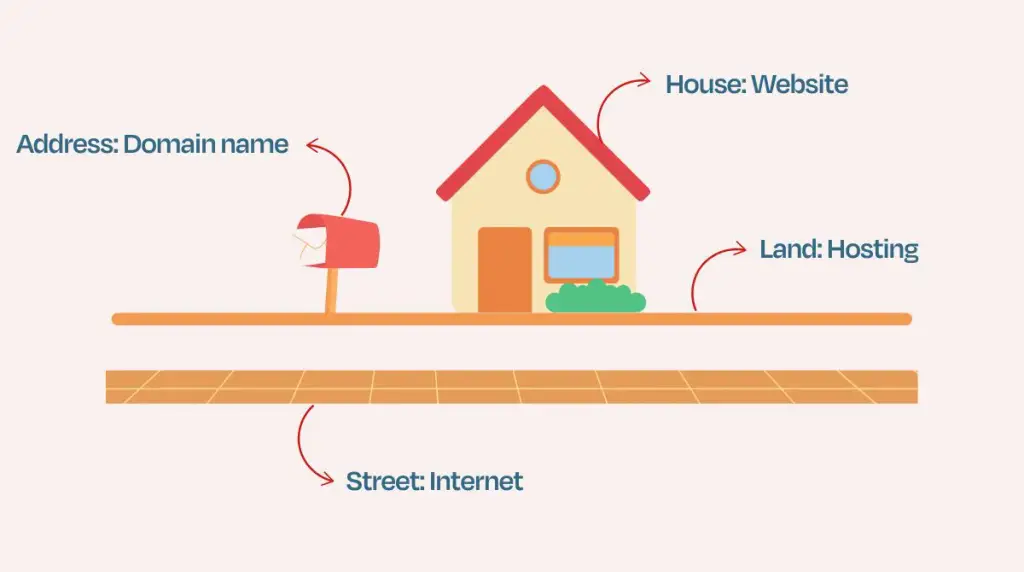
The simplest way to understand it is:
| Domain | Hosting |
|---|---|
| Your website’s address | Where your website is stored |
| Example: yourbusiness.co.za | The server where your website lives |
| Registered annually | Usually paid monthly or annually |
| Helps people find your website | Makes the website accessible online |
You generally need both if you want a normal business website.
And then there’s a third component:
Your website
Your website is the actual digital experience customers interact with.
It includes things such as:
- Your homepage
- About page
- Services
- Contact information
- Images
- Blog or insights
- Forms
- Products
- Calls to action
- Content
- Design and branding
So, in simple terms:
Domain + Hosting + Website = Your online presence
How Much Does a Domain Cost in South Africa?
Domain prices vary depending on the extension, registrar and whether you’re looking at an introductory price or renewal price.
For example, current South African market pricing shows .co.za domains commonly available around the R100-per-year range, although prices vary between providers and can change over time.
The important thing isn’t simply finding the cheapest domain.
Before registering a domain, check:
- The initial registration price
- The annual renewal price
- Whether VAT is included
- Whether the domain is registered in your name or business’s name
- Transfer conditions
- What happens if the domain expires
Don’t choose a domain based only on price
Your domain can become an important business asset.
If you’ve already built your brand around a particular domain, changing it later can create unnecessary work involving:
- Website URLs
- Business email
- Google Business Profile
- Search engine indexing
- Marketing materials
- Social media profiles
- Printed material
- Customer recognition
Choose carefully before you build your entire online presence around it.
How Much Does Website Hosting Cost in South Africa?
Hosting prices vary considerably depending on the type of hosting, storage, performance, support and features included.
For example, current South African hosting options can start around the lower end of the market for basic websites, while managed WordPress, VPS and higher-performance hosting can cost considerably more.
Rather than choosing the cheapest package, consider what your website actually needs.
A small business website may need:
- Reliable hosting
- Enough storage
- SSL
- Regular backups
- WordPress compatibility if using WordPress
- Adequate server resources
- Email hosting if required
- Customer support
- Easy management
- Room to grow
A cheap hosting package that causes frequent problems can ultimately cost your business more than paying for reliable hosting from the beginning
What Type of Hosting Does a Small Business Need?
There isn’t one hosting solution that’s right for every business.
The right option depends on your website, traffic, functionality and future plans.
1. Shared Hosting
Shared hosting places multiple websites on the same server environment.
It’s often suitable for:
- Small business websites
- Brochure websites
- Personal websites
- Basic service websites
- New businesses
For many smaller businesses, shared hosting can be enough when the website is properly optimised and the hosting environment is appropriate.
2. WordPress Hosting
If your website runs on WordPress, you may consider WordPress-specific hosting.
Depending on the provider, WordPress hosting may include features designed around WordPress websites, such as:
- WordPress installation
- Performance optimisation
- Security features
- Backups
- WordPress support
This can be particularly useful for businesses that rely on WordPress for their website.
3. VPS Hosting
A Virtual Private Server provides more resources and control than typical shared hosting.
It may make sense for:
- Larger websites
- High-traffic websites
- Applications requiring additional resources
- Businesses with specific technical requirements
However, most small businesses don’t automatically need a VPS.
More expensive doesn’t necessarily mean better for your particular website.
4. Managed Hosting
Managed hosting can provide additional technical support and server management.
This can be useful when a business doesn’t want to spend time dealing with server configuration, updates, security and technical maintenance.
The key question is:
What does your website actually require?
Don’t pay for resources you don’t need — but don’t choose a hosting package so limited that your website struggles as your business grows.
Does Web Hosting Affect SEO?
This is where there’s a lot of misinformation online.
Hosting isn’t a shortcut to higher Google rankings.
You don’t improve your website’s authority simply by moving to a particular hosting provider.
SEO depends on many factors, including your content, website structure, technical implementation, relevance, user experience, links, reputation and other signals.
However, your hosting environment can still matter to the overall quality and performance of your website.
A poorly performing website can create problems such as:
- Slow loading
- Downtime
- Poor user experience
- Server errors
- Resource limitations
- Difficulty handling traffic spikes
Google’s broader guidance is to focus on creating helpful, reliable, people-first content and a good experience for visitors rather than trying to manipulate individual ranking signals.
That’s why we look at hosting as part of the technical foundation of a website, not an SEO magic trick.
Does Hosting Location Matter for a South African Website?
Hosting location can be one consideration when choosing a hosting provider, particularly if most of your customers are in South Africa.
However, don’t assume that a South African business must automatically use a South African server to rank in Google.
Website performance depends on several factors, including:
- Server infrastructure
- Network configuration
- Caching
- Content delivery
- Website code
- Image optimisation
- Plugins
- Database performance
- Hosting resources
Your hosting provider is only one part of the performance equation.
A well-designed website on appropriate hosting can perform considerably better than a poorly optimised website on an expensive hosting package.
What Should You Look For When Choosing Hosting?

Before purchasing hosting, look beyond the headline price.
1. Reliability
Your website needs to be available when customers are trying to find you.
Ask about uptime, infrastructure and what happens when problems occur.
2. Performance
Check what type of storage and server resources are provided.
Performance isn’t just about having a “fast hosting” label. Your website itself also needs to be properly built and optimised.
3. SSL
Your website should use HTTPS.
SSL helps secure the connection between the visitor and your website and is now a basic expectation for professional websites.
4. Backups
Ask how often backups are created and how long they are retained.
More importantly, understand whether you can actually restore your website if something goes wrong.
5. Support
When your website goes down, you don’t want to discover that support is difficult to reach.
Look at the support options and response process before you buy.
6. Scalability
Your hosting should be capable of growing with your business.
You might start with a small service website and eventually add:
- Online bookings
- Ecommerce
- Membership functionality
- More traffic
- Additional websites
- Advanced integrations
Your hosting needs may change as your business grows.
Do You Need Domain and Hosting Before Building a Website?
Not necessarily.
A professional web designer or agency can often help you choose and configure the domain and hosting as part of the website project.
In fact, it’s usually better to think about the website, domain and hosting together.
For example, your website might require:
WordPress + specific hosting requirements + SSL + business email + backups + performance optimisation.
Choosing hosting first without considering the website you’re actually going to build can result in limitations later.
Should You Buy Your Domain and Hosting From the Same Company?
You can.
Having your domain and hosting with the same provider can make management simpler because you have fewer accounts and fewer companies to deal with.
However, it isn’t a requirement.
You can have:
Domain → Provider A
Hosting → Provider B
Website → WordPress
This can work perfectly well.
The most important thing is that you retain proper control of your domain and understand who has access to your hosting and website.
Who Should Own Your Domain?
This is an important question that businesses sometimes overlook.
Your business should have control over its domain.
If someone registers your domain on your behalf, make sure you understand:
- Whose name the domain is registered under
- Which account controls it
- Who receives renewal notifications
- Who has access to DNS
- How the domain can be transferred
Your domain is part of your digital business identity.
Don’t allow it to become locked inside someone else’s account without a clear agreement.
What Do You Actually Need to Get Your Business Online?
For most small businesses, the basic setup looks something like this:
1. A domain
Your online address.
2. Website hosting
The environment where your website is stored.
3. A website
Your actual online presence.
4. SSL / HTTPS
For secure connections.
5. Professional content
Your website should clearly communicate:
- Who you help
- What you offer
- Why customers should choose you
- How customers can contact you
6. SEO foundations
Your website should have a structure that allows search engines and users to understand your business.
7. Analytics and Search Console
These tools can help you understand website performance, search visibility and user behaviour.
8. Ongoing maintenance
Launching your website isn’t the end.
Websites need ongoing attention to:
- Security
- Software updates
- Backups
- Content
- SEO
- Performance
- Broken links
- Conversion opportunities
Domain and Hosting Are Not the Same as Web Design
This distinction is important.
Buying a domain and hosting does not mean you have a professional website.
You could have:
Domain + Hosting = R1,000
and still have:
No website strategy.
A business website needs to do more than exist.
It should help visitors quickly understand what you do and make it easy for the right people to take action.
That’s where professional web design, SEO and conversion strategy become important.
Your Website Should Be Built Around Your Business Goals
Before choosing colours, fonts or animations, ask:
What should this website achieve?
For one business, the goal might be generating enquiries.
For another, it might be selling products.
Another business may need bookings, applications or lead generation.
Your website structure should reflect that goal.
For example:
Traffic → Relevant landing page → Trust → Value proposition → CTA → Enquiry
This is why good web design isn’t simply about making a website look professional.
It’s about creating a digital experience that helps move the right visitor toward the right action.
When Should You Work With a Professional Web Design Agency?
DIY website builders can be useful for simple projects.
But professional web design becomes particularly valuable when your website is expected to contribute directly to business growth.
Consider professional help if:
- Your website isn’t generating enquiries
- Your current website looks outdated
- Your visitors aren’t taking action
- Your website isn’t ranking well
- Your mobile experience is poor
- You don’t know what pages you need
- Your website loads slowly
- You’re struggling with SEO
- You need ecommerce functionality
- You’re launching a new business
- Your website doesn’t communicate your value clearly
A good agency should look beyond the visual design.
It should consider strategy, structure, content, SEO, user experience and conversions.
Need a Domain & Hosting for Your New Website?
A professional website needs a reliable foundation.
If you’re launching a new website or upgrading an existing one, choosing the right domain and hosting is an important part of getting your business online.
If you’re ready to get started, you can explore domain and hosting options here:
Get your domain & hosting here
Affiliate disclosure: This page contains an affiliate link. If you purchase qualifying services through this link, we may earn a commission at no additional cost to you.

Ready for a Website That Does More Than Look Good?
Your website shouldn’t simply be an online business card.
It should help your business get found, build trust and generate action.
At Signal Growth Partners, we combine web design, SEO and digital marketing to create websites designed around business goals — not just aesthetics.
If your current website isn’t generating the results you expect, it may be time to rethink the strategy behind it.
Explore Our Web Design Johannesburg
Final Takeaway
Your domain is your address. Your hosting is where your website lives. Your website is what your customers experience.
Getting these foundations right matters but the real goal isn’t simply to get your business online.
It’s to build an online presence that helps the right people find you, trust you and take action.
That’s where strategic web design and SEO come in.
Frequently Asked Questions
No. Your domain is your website’s internet address, while hosting is where your website’s files are stored.
Yes. A standard website needs a hosting environment so its files can be delivered to visitors online.
Hosting alone does not improve your Google rankings. However, reliable hosting and good website performance form part of a healthy technical foundation for your website.
Yes. If you’re building a new website, we can help you understand what you need and ensure your website’s domain, hosting, design and SEO foundations work together.
